









New Research Reveals UK Dog Population May Have Been Underestimated by Up to Four Million, with Surprising Regional Hotspots
- Research by Dogs Trust, University of Exeter and University of Leeds found dog population to be around 13 million – four million higher than previous estimates.
- Telford and Darlington revealed at UK dog hotspots.
- New research will make it possible to track shifts in breed popularity and monitor the welfare implications of these changes, something Dogs Trust describes as a “game-changer”.
We are a nation of dog lovers, but according to new research from Dogs Trust, the UK dog population may have been underestimated by up to as much as four million.
Dogs are the most popular pet within the United Kingdom, with 31% of households owning at least one, but while previous population estimates – including those based on public surveys – put the population between 9 million and 11.5 million in 2019, new research from Dogs Trust based on the same period, has revealed that the population may have been nearer to 13 million.
Previously, estimating the total dog population in the UK was challenging due to a lack of comparable and accessible data. Dogs Trust has collaborated with researchers from the University of Leeds and the University of Exeter to combine and model data from 18 diverse sources – including a breed registry, an academic institution, veterinary organisations, pet insurance companies, and animal welfare charities – to create a more accurate picture of our canine companions.
Dog Hotspots

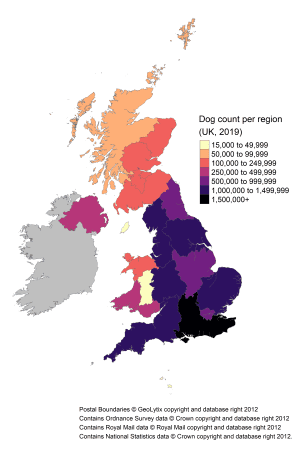
Not only did this study – the most comprehensive review of dog population ever conducted in the UK – possibly the world – show there were more dogs than previously thought, but it also revealed the areas of the country with the greatest ratio of dogs to people. The study found Telford and Darlington to be the dog hotspots of the UK, with eight dogs for every 20 people
Compared to people, the lowest densities of dogs were reported for six areas of London, covering postcode areas N, E, SW, WC, W and UB – here, for every 20 people, there was approximately one dog. , for every 20 people, there was approximately one dog.
83% of dogs called England home, with the South East and North West regions being the most dog-packed areas. 9.1% of the UK’s dogs were found in Scotland, with South Scotland and Lothian as the dog hotspots north of the border.
Meanwhile, Wales was home to 5.8% of the UK’s doggy population, with South and West Wales being the most populated. Completing the picture, Northern Ireland was home to 2.1% of the UK’s dog population.
This new study has been designed in a way that means the dog population of the UK can be closely monitored over time, making it possible to track shifts in breed popularity and monitor the welfare implications of these changes, something Dogs Trust describes as a “game-changer” when it comes to understanding our furry friends and ensuring they receive the care they need.
Dr Kirsten McMillan, Deputy Head of Research at Dogs Trust, says:
“The UK is well known for being a nation of dog lovers, but it turns out we may have significantly underestimated how many dogs are out there by over four million! This inaccuracy can have serious implications as it affects important statistics like how many dogs of different breeds or sizes live in certain regions, how the dog population grows each year, and the overall trends in dog ownership.”
“This new study is the most comprehensive analysis of the dog population in the UK to date. It’s packed with valuable insights for everyone involved in dog welfare and our friends within the welfare sector, veterinary care, epidemiological, and business fields. With plans to replicate this study in the future, we’ll be able to track changes in dog populations over time, helping us better understand the changing population, including breed popularity and its impact on welfare.
“It’s been fascinating to uncover stark differences in dog density throughout the UK, with Telford and Darlington emerging as leaders, boasting the highest dog-to-human ratios. These and future statistics provide valuable insights into regional trends and the dynamics of pet ownership across the country.”
Dr David Wong, Associate Professor of Health Data Science and Health Informatics at the University of Leeds, said: “This groundbreaking study sheds new light on the UK’s dog population and density. Supporting the research team to develop a better understanding of our canine companions has been an incredibly rewarding experience. Dogs Trust have excelled in bringing together a diverse range of stakeholders and experts to deliver insights that will underpin research for many years to come.”
Dr Xavier Harrison, Senior Lecturer at the University of Exeter, said: “Knowing how many dogs there are in the UK is important, but isn’t necessarily straightforward to calculate. Up to date estimates of the size and distribution of the dog population within the UK, and how these trends vary by breed and age, allow us to highlight where and why certain breeds are more popular. More importantly, they provide a solid baseline for investigating what factors that may drive changes in dog ownership in the future, with consequences for human and pet health.”
The study also uncovered some intriguing insights into the age distribution of dogs across the UK. Notably, Northern Ireland had the highest national proportion of older dogs, with more than half its canine population classified as either geriatric (over 12 years; 16.9%) or senior adult (ages 7 to under 12; 38.9%). Meanwhile, Scotland had the largest national share of mature adult (2 to < 7 years) dogs, making up 40.4% of its population. Interestingly, the study found little variation in the proportions of puppies, juveniles and young adults across the UK, indicating a more uniform age distribution in those categories.
Help keep news FREE for our readers
Supporting your local community newspaper/online news outlet is crucial now more than ever. If you believe in independent journalism, then consider making a valuable contribution by making a one-time or monthly donation. We operate in rural areas where providing unbiased news can be challenging. Read More About Supporting The South Wales Chronicle